

What are grinding tools?
Grinding (that is, the breaking, crushing, or reduction of materials into small particles or powder through pressure and friction) requires a pair of tools working together. On the one hand, there is a lower, stationary implement — the passive tool — commonly referred to in the bibliography as a quern, saddle quern, grinding slab, or metate. On the other hand, there is an upper mobile implement — the active tool — described by terms such as handstone, grinder, or mano. The surfaces of the two tools that come into contact during use are referred to as “use-surfaces” or “active surfaces”. During grinding, the handstone moves over the quern in either a rectilinear or a curvilinear motion, processing material between the two use-surfaces.
In prehistoric Greece, three main grinding tool types can be distinguished, based on the kinematics involved as well as the morphology and size of the handstone. The most common type appears to be the pair consisting of an elongated handstone whose edges extend beyond the margins of the quern surface. This type operated through a reciprocal back-and-forth motion (Figure 1).
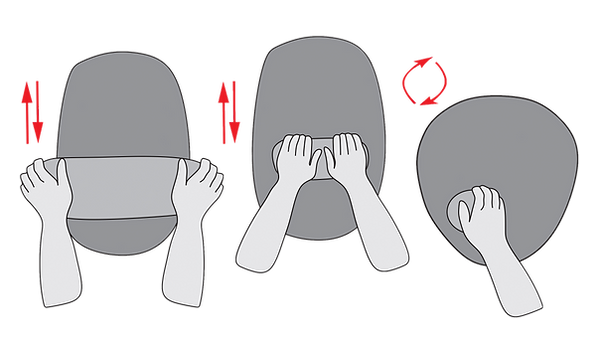
Drawing © Chondrou; originally published in Chondrou 2018
Why study grinding tools?
Technology is embedded within systems of production and economic practice. At the same time, it is produced and reproduced within specific social and cultural settings that shape human actions, influence technical choices and behaviours, and regulate the meanings embedded in both material and immaterial elements. Therefore, technology –in our case grinding technology in particular - carries not only an economic but also a socio-cultural dimension that can be analytically approached.
Through its study, we can address key questions concerning the organization of prehistoric societies.
What is the focus of GrindTrace?
The project focuses on grinding tools from a series of Neolithic settlements located in central and northeastern Greece, all dating to the later phases of the Neolithic, roughly between 4700 and 3300 BC.
The main aim of GrindTrace is twofold:
a) to expand our understanding of the technical and cultural parameters shaping grinding technology and
b) to shed light on the societies of the transitional period between the Neolithic and the Bronze Age era - a period of Greek prehistory that remains relatively understudied, a period of change and low visibility that followed a generalized abandonment of flourishing Neolithic settlements marking the end of the 5th mill. BC
The sites
